
Skip to content
DREAMSCAPESEDTECH

Our approach

Purposefully designed. Evidence-informed. Built for impact.

We bring together parent involvement, immersive gameplay, structured learning and values-based character development in one cohesive experience.

Four pillars

One integrated digital experience

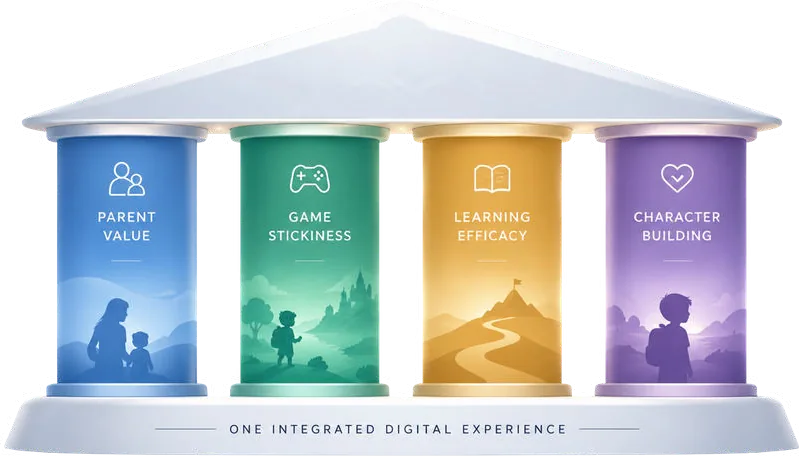
Four pillars labelled Parent Value, Game Stickiness, Learning Efficacy and Character Building supporting one integrated digital experience
1

Parent value

A safe, purposeful digital experience that connects parents with their children's play and development.

  • Safe & purposeful entertainment. Child-appropriate experiences with intentional, values-aligned content.
  • Education as added value. Digital play enriched with structured learning and developmental tools.
  • Visibility, insights & participation. Parents see progress, understand the learning, and get practical tips to join in.
2

Gameplay stickiness

Child-centred design, shaped by research and playtesting, that children want to come back to.

  • Immersive virtual world. Curiosity, exploration, discovery and social interaction.
  • Avatar-driven gameplay. Children navigate, interact and express themselves through their Guardian.
  • Progression-driven engagement. Missions, challenges and meaningful rewards motivate continued play.
3

Learning efficacy

Structured learning and evidence-informed pedagogy build academic foundations and a growth mindset.

  • Curriculum-structured learning. Aligned with Cambridge objectives and school-grade frameworks.
  • Evidence-informed pedagogy. Metacognition, Self-Determination Theory, project- and place-based learning.
  • Measurable outcomes. Tracking progress and knowledge transfer.
4

Character building

Values-driven storytelling that nurtures character, ethical decision-making and social-emotional skills.

  • Values-driven experiences. Values woven into stories and gameplay.
  • Moral decision-making. Children consider consequences, take responsibility and make thoughtful choices.
  • Social-emotional development. Empathy, compassion, patience and positive relationships.

Pedagogy

Learning science, built into play

Every mission applies established, pilot-tested approaches to how children learn.

Self-Determination Theory

Autonomy, competence and relatedness fuel intrinsic motivation, so children want to learn rather than have to.

Metacognition

Children reflect on how they solved a problem, building independent learners who can transfer what they know.

Project-based learning

Missions are projects with a real goal, such as saving a forest, so knowledge is applied rather than memorised.

Place-based learning

Exploring biodomes, habitats and space grounds abstract ideas in places children can walk through.

Curriculum

Grounded in Cambridge Primary Science

Missions map to chapters of the Cambridge Primary Science curriculum, Years 1–6. Parents see exactly which chapter each mission covers, from identification keys in Year 4 to the Earth's movements in Year 5.

Malaysia's KSSR, Singapore's syllabus, and IB and US curricula are planned next.

  • Living things

    Learning labs: Botany (plants) · The wild (animals)

  • Space & planets

    Learning labs: Space Center

  • Electricity & magnets

    Learning labs: Gadget Center

Character & values

Growing good people, not just good students

Each mission carries a moral and a piece of wisdom that parents can talk through with their child. Our values are inspired by the teachings of Jesus: love for others, honesty, humility and care for creation, expressed in stories every family can enjoy.

  • Social morals

    Kindness, honesty, forgiveness and working together.

  • Personal morals

    Responsibility, perseverance, self-control and courage.

  • Environmental morals

    Caring for creation, and for every living and non-living thing.

The research

Why parental involvement matters

Two large meta-analyses link children's screen use, particularly gaming, with emotional and behavioural problems. Both point to the same answer.

Meta-analysis, 2025[1]

117 studies · 292,739 children

Screen use and socioemotional problems over time, including gaming.

Meta-analysis, 2022[2]

87 studies · 159,425 children

Screen duration and behavioural problems in children aged 12 and under.

Key observation

Parental involvement can make a difference.

Quality content

Children need age-appropriate, purposeful and meaningful digital experiences.

Parent–child connection

Digital entertainment can be an opportunity for parents and children to engage together.

  1. [1] Meta-analysis of 117 studies (292,739 children), 2025. Full citation to follow.
  2. [2] Meta-analysis of 87 studies (159,425 children), 2022. Full citation to follow.

See it in Eternal Guardians